
The case for Commons World
Why It Matters

01The premise
A working design for
civilisational governance
Commons World is a working design for how decisions get made, how truth gets recorded, how enterprises are held accountable to what they actually do, and how the people affected by a decision get a real voice in it.
It is not a political party, a protest movement, or a set of value statements. It is a system of nine interlocking Pillars, each performing a distinct function, designed to be built, operated, and verified like any serious piece of infrastructure.
If you are encountering Commons World for the first time, the natural question is not “what does it believe?” but “what does it do?” The honest answer is that it closes gaps: the specific, repeatable gaps in our current systems that allow harm to occur, persist, and go unaddressed even when everyone involved can see it happening.
This page sets out what those gaps are, why they have proven so difficult to close by conventional means, and how the architecture is designed to close them.
How we arrived here Optional background
None of this happened by design, in the sense of anyone intending it. Most of the systems now governing planetary life, including national regulatory bodies, joint-stock enterprise, international trade law, mass media, and the modern nation-state itself, were built incrementally, over centuries, to solve the problems of their own time. Each layer made sense on its own terms. A regulator was created because a specific harm had become visible and public pressure demanded a response. A disclosure rule was added because a specific scandal had exposed a specific gap. None of these additions were designed with the others in mind, and none were designed against a shared standard of evidence, accountability, or transparency.
The result, accumulated over two centuries of industrial and post-industrial development, is not a system so much as a patchwork of systems. Each is internally coherent, none is coordinated with the others, and none was built to the same standard. A financial regulator in one country operates on entirely different evidentiary standards than an environmental regulator in another. A corporation can meet every disclosure requirement in its home jurisdiction while its actual environmental and social impact, in the jurisdiction where its supply chain operates, remains almost entirely undocumented. This is not a conspiracy.
It is what happens when governance is built one crisis at a time, by different actors, on different timelines, with no shared architecture underneath.
As the twentieth century gave way to the twenty-first, the pace and interconnection of global systems accelerated far faster than the patchwork governing them. Supply chains now span continents in ways nineteenth-century regulatory boundaries were never built to track. Information now moves at a speed no nineteenth-century press law anticipated. Ecological systems that took millennia to stabilise are now measurably shifting within single human lifetimes. The patchwork has not kept pace, not because the people maintaining it are careless, but because patchwork governance was never designed to operate at this speed or this scale in the first place.
The problem is not a lack of concern. Decision and consequence have come apart.

02The diagnosis
The diagnosis
The visible failures differ. The underlying mechanism is the same.
Almost every major failure of the last century, examined closely, traces back to the same underlying condition: the people who make a decision are separated from the people who live with its consequences.
- A regulatory approval is granted in one office; the pollution it permits is breathed in a different part of the country, often years later, by people who had no say in the approval.
- A lending decision is made in a boardroom; the debt it creates is carried by a household that never sat at that table.
- A curriculum is set by a ministry; the gaps it leaves are inherited by a child who will not discover them until adulthood.
This separation is not incidental. It is structural, and it is self-reinforcing. Once decision and consequence are separated, the people making decisions lose the most reliable signal that would otherwise correct their course: the direct experience of what their decisions produce. Institutions built on this separation do not need to be corrupt or malicious to fail. They simply lose the feedback loop that would tell them they are failing, until the failure is large enough to be undeniable. By then, the cost of correction is far higher than the cost of prevention would have been.
The specific failures look different: a collapsed fishery, a contaminated water table, a financial crisis, a public health emergency, a wave of misinformation.
What makes this moment different from earlier periods of institutional strain is compounding. A separation between decision and consequence that produces a slow, local harm in a low-interconnection world produces a fast, global harm in a high-interconnection one. The same structural gap that once meant a single regulator missed a single problem now means that gap, replicated across every jurisdiction and every sector simultaneously, can allow a single class of failure to compound across the entire interconnected system at once.
- This pattern repeats across every domain that matters to human life:
- the ecological systems we depend on
- the food and water we consume
- the health systems meant to protect us
- the financial systems meant to serve us
- the information systems meant to inform us
- the governance systems meant to represent us
03Why systems stall
Why existing systems cannot
reliably correct themselves
Democratic institutions, markets, regulators, and the press can expose failure. In practice, three structural weaknesses prevent correction from happening reliably.
Permanent, independent evidence is often missing
Most claims about what an institution or enterprise has actually done (what it emitted, what it paid, what it promised, what it delivered) exist only in that institution’s own records, produced on its own terms, and disclosed at its own discretion. When a dispute arises, there is often no independent, tamper-resistant account to settle it. The truth becomes a matter of competing claims rather than verifiable fact.
Oversight can be captured by the interests it oversees
Any regulator powerful enough to hold a large enterprise accountable is, by the same token, valuable enough for that enterprise to influence: through funding, through employment pipelines, through simple asymmetry of resources and expertise. Over time, even well-designed regulatory bodies tend to drift toward the interests of the industries they regulate, not because individuals are corrupt, but because the incentives on each side are structurally unequal. The regulated party has far more at stake in every single decision than the regulator does, and will invest accordingly.
Transparency remains the exception, not the default
Disclosure, in almost every system we currently operate, is something an institution chooses to do, is compelled to do after the fact, or manages to avoid doing entirely. There is no architecture in most domains that makes concealment structurally difficult rather than merely frowned upon. Where transparency is optional, it is, over enough time and enough institutions, generally deferred.
Put together, these three weaknesses explain why so many reforms fail to hold: a new regulator here, a new disclosure requirement there. Each treats the specific failure in front of it. None changes the conditions that produced the failure and will produce the next one. A system without permanent evidence, without protection from capture, and without default transparency will keep generating the same category of failure indefinitely, regardless of how many new rules are layered on top of it.
A fourth weakness compounds the first three: institutions reward short-term, locally visible success over long-term, widely distributed wellbeing.
An elected official is rewarded for outcomes visible before the next election, not outcomes that mature over a decade. A publicly listed enterprise is rewarded for the next quarter’s results, not the next generation’s environment. This is not a flaw in the individuals occupying these roles. Many of them would choose differently if the system rewarded it. It is a flaw in what the system measures and pays out for. Institutions optimise for what they are measured against, and almost nothing currently in place measures the things that matter most over the timescales that matter most.
04The architecture
Nine distinct jobs,
one continuous system
Commons World starts from a different premise: that these weaknesses are solvable by design, not by good intentions. Rather than adding another layer of oversight to systems that were never built to be overseen, it specifies a parallel architecture built from the ground up around permanent evidence, resistance to capture, and default transparency.
That architecture is organised into nine Pillars, each responsible for a distinct function, and each designed to operate independently of any single government, corporation, or ideology, so that no single actor, however powerful, can capture the whole system by capturing one part of it. Briefly, the nine Pillars are:
-
Planetary Coherence & HealthEstablishes permanent, independent baselines for ecological and human wellbeing rather than relying on self-reported data.
-
Commons RegistryRecords verified facts in a form that cannot be quietly altered or withdrawn.
-
Alliance for Transparent EnterpriseSubjects enterprise conduct to continuous, non-voluntary verification rather than occasional audit.
-
Global Accountability RatingTurns that verified conduct into a standard, comparable measure of institutional trustworthiness.
-
Commons Bank & Commons Unit of ExchangeReorganises how value is issued and held so that finance serves the real economy rather than the reverse.
-
AURA (Autonomous Unified Rights Architecture)Gives individuals direct, portable control over their own identity, data, and rights.
-
Commons EducationBuilds an evidence-based curriculum insulated from the funding pressures that currently shape what is taught.
-
Open Story NetworkDistributes verified information at the speed misinformation currently enjoys unopposed.
-
Evolutionary LeagueContinuously scans for emerging risks and coordinates the system’s response to them.
What matters at this introductory level is not the detail of any single Pillar, but the property that emerges from all nine operating together: a system in which evidence is permanent instead of contestable, verification is continuous instead of occasional, and no single point of failure or capture can bring the whole architecture down. This is the same design principle used in resilient infrastructure of any kind: redundancy, independence between parts, and no single point through which the entire system can be compromised.
Observe
Record
Account
Act
What is learned returns to the next decision
- Because verification under this architecture is continuous and independent rather than periodic and self-reported, the absence-of-evidence problem does not recur in the same form.
- Because no single Pillar controls the whole system, and no single actor (government, corporation, or otherwise) can capture more than one function at a time, the capture problem is structurally harder to reproduce.
- Because transparency is the default condition of the architecture rather than a compliance obligation layered on top of it, concealment requires actively working against the system’s design rather than simply declining to disclose.
Every Pillar is held in trust for humanity: not owned by a state, a company, or any one person.
The two free books set out the argument and the full architecture.

05What changes
Change the conditions,
not the promise
Commons World is not a call for people to behave better. It is a change to the conditions under which behaviour occurs. Systems built on permanent evidence and default transparency do not depend on the goodwill of the people operating within them to produce good outcomes. They make certain categories of harm structurally difficult to commit and structurally easy to detect, in the same way a well-designed financial control system does not depend on every employee being honest to prevent large-scale fraud.
This is the level at which Commons World is intended to operate: not correcting individual failures after they occur, but changing the structural conditions that currently make those failures likely, recurrent, and slow to correct.
That is a large claim, and it deserves to be treated as one: not as a guarantee, but as a design proposition, open to scrutiny, testing, and refinement. Commons World does not ask to be taken on faith. It asks to be examined against the same standard any serious piece of infrastructure is examined against: does the design actually address the failure mode it claims to address, and can it be built.
It does not make bad behaviour impossible. It makes bad behaviour observable, attributable, and correctable.
It is worth being clear about what this is not. It is not a claim that human nature can be redesigned, or that conflict, error, and disagreement will disappear once this architecture is in place. People will still make mistakes, pursue narrow interests, and disagree in good faith about what should be done. What changes is not human nature but the operating conditions those decisions are made within: conditions where the evidence needed to catch a mistake exists and persists, where no single actor can quietly capture the process, and where the people affected by a decision have a standing, structural means of being heard rather than an occasional, discretionary one. That is a more modest claim than a promise of a perfect world, and a far more credible one.
Why this should succeed where earlier reforms have not
It is a fair question to ask why a nine-Pillar architecture should succeed where a century of regulators, treaties, and reform movements have not. The honest answer is not that Commons World has better intentions. Most of the institutions it seeks to complement or replace were also built with good intentions. The answer is that it targets the mechanism rather than the symptom, and it is built, from the outset, to resist the specific failure modes described above.
This is also why Commons World is designed to be built incrementally, starting in specific places, rather than requiring simultaneous global adoption to have any effect. The same nine-Pillar architecture can be applied to a single national context first, so that its instruments can be tested, refined, and demonstrated against real conditions before being extended elsewhere.
An architecture that only works if adopted everywhere at once is not a workable architecture. One that works while adopted in a single place, and becomes more effective as more places adopt it, is.
Read the publications
Commons World is set out in full across two free publications, both available to download now.

The entry point
Commons Community
A Field Guide to Commons World
The shortest and most accessible entry point, written for individuals and groups exploring the architecture together for the first time.
Explore Commons Community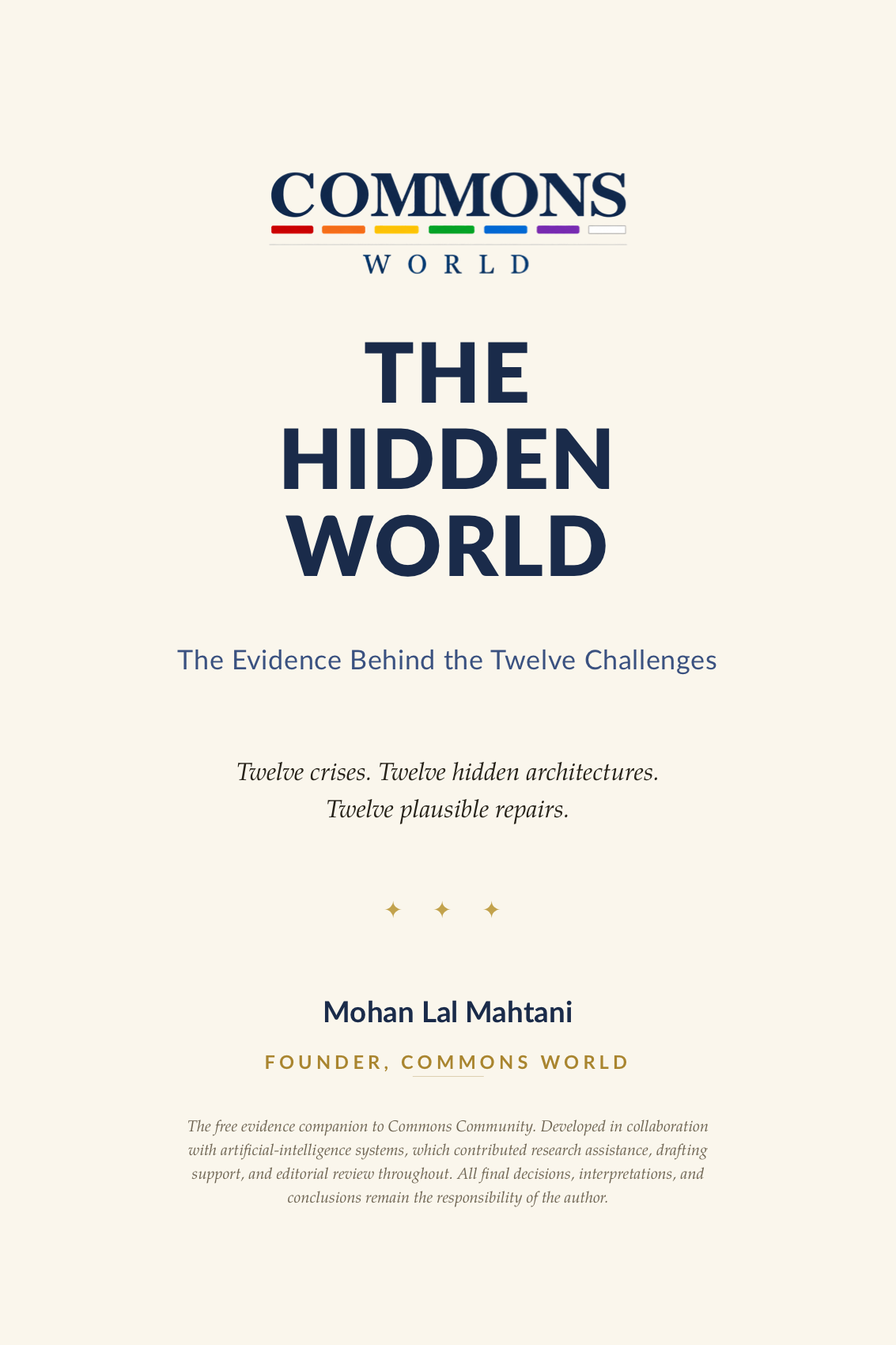
The evidence companion
The Hidden World
The Evidence Behind the Twelve Challenges
The evidence companion, tracing twelve urgent challenges from their root causes to the structural response proposed for each.
Explore The Hidden World