Skip to content

Commons World

Read the framework tonight.

Two free books by Mohan Lal Mahtani — Commons Community, the field guide, and The Hidden World, the evidence. Enter your email and both PDFs arrive instantly.

  1. Commons Community the field guide free now
  2. The Hidden World the evidence free now
  3. The Visible World the founding book print, 2027

Free · Two PDFs

Get both books, free

Enter your email and we’ll send both PDFs right away — and welcome you to the community around the books.

We’ll only use this to send the books and occasional updates — unsubscribe anytime.

Commons Community — A Field Guide to Commons World

Book one · Start here

Commons Community

A Field Guide to Commons World

“Sovereignty is not conferred from above. It is a capacity that exists in you.”

The entry point. A short booklet meant to be read in one sitting and used as a meeting guide. No prior reading required.

Start here

The entry point is here — read it in one sitting, then run your first meeting.

Get your copy — free ↓

Read the opening

Part one · An honest invitation

Something is wrong with the world. Most people sense it. The difficulty is not in sensing it — it is in seeing it clearly enough to know what to do, and in finding others who see the same thing.

Somewhere today a nurse will finish a second consecutive shift, a farmer will coax another season out of exhausted soil, and a parent will sit up through the night with a sick child — and not one of those hours will register in any figure a government calls “the economy.” In the same year, 2025, the twelve richest individuals on Earth came to hold more wealth than the poorest half of humanity combined. These are not two separate facts. They are two ends of a single arrangement.

This booklet exists because of that difficulty. It is for anyone who has read The Visible World and wants to think about it with others. It is equally for anyone who has not read it — who found this booklet online, received it from someone, or walked into a room where a Commons Community was meeting. You do not need to have read the book to belong here. What you do need is a willingness to look honestly at what is happening in the world, and a desire to be part of something that is working to change it — not through outrage, not through campaign, but through clear sight, shared in community.

Commons World is not a political party, a religion, or a movement with a central organisation. It is a framework — nine interconnected institutions designed to make the world’s most important things visible: who is accountable for what, who is contributing to what, who is benefiting from what, and who is bearing the cost. The Commons Community is where that framework meets daily life. You do not need permission to begin. You need only a room, one other person, and a willingness to see clearly together.

The world contains enough food, enough water, enough energy, and enough human ingenuity to ensure that every person on Earth lives with dignity. This is not a utopian claim. It is an observation about resources and capacity. The reason most people do not experience this as the reality they inhabit is not a lack of resources. It is a question of how those resources are owned, directed, and accounted for — and by whom. Something has been taken from most people — not in a single dramatic moment, but gradually, through thousands of decisions made by a small number of people in positions of institutional power, over many decades. The taking has happened across five dimensions. Together they describe the condition the world is in.

— the full book is free. Get the PDF ↓

The Hidden World — The Evidence Behind the Twelve Challenges

Book two · The evidence

The Hidden World

The Evidence Behind the Twelve Challenges

“Twelve crises. Twelve hidden architectures. Twelve plausible repairs.”

The evidence companion to Commons Community. Expands each of the twelve priority challenges into a full chapter — a specific named case, the exact law or doctrine that permits it, the pattern repeating elsewhere, and the specific fix — all sourced.

When you're ready to go deeper: the twelve challenges, case by case — named companies, exact laws, and the repair each would take.

Get your copy — free ↓

Read the opening

Before we begin · Introduction

The world runs on hidden architecture. Not the official architecture — the legislation, the treaties, the regulatory frameworks whose existence most people are broadly aware of even if they cannot name them. The hidden architecture is the layer beneath: the specific clauses, the individual court decisions, the industry-authored amendments inserted into omnibus legislation at the last moment, the regulatory gaps created not by accident but by the sustained effort of the people who benefit from them. This book is about that layer.

Twelve challenges. Twelve domains in which the gap between what is publicly claimed and what is actually happening is not a matter of disputed interpretation but of documented, verifiable fact. In each case, the challenge is real, the evidence is available, and the people who would need to act to address it have received that evidence and chosen not to act — or have been structurally prevented from acting by the same architecture that produced the problem.

This is not a book about inevitable decline. The working examples in each chapter — the Montreal Protocol, the Amazon Soy Moratorium, the Loess Plateau restoration, the Welsh Well-being of Future Generations Act, the Aral Sea partial recovery — demonstrate that the same pattern that produces failure can produce repair when the structural conditions are different. The structural conditions that make repair possible, rather than merely necessary, are what this book is ultimately about.

The Hidden World is the evidence companion to Commons Community. Commons Community introduces Commons World — a governance architecture built around nine Pillars designed to address the root causes of the failures this book documents. The Hidden World does not repeat that architecture in full. It demonstrates, case by case, why that architecture is necessary. Each of the twelve chapters that follow examines one of the twelve Thematic Priority Challenges that Commons World was designed to address. Each chapter opens with a specific, named case — a law, a company, a decision, a date — that makes the systemic failure concrete and human. Each chapter closes with a brief account of what changes when the relevant Pillars of Commons World are in place. The changes are not speculative. They follow directly from the architecture.

In 1926, the United States Congress passed a percentage depletion allowance for oil producers: the right to deduct 27.5 percent of gross well income from taxable earnings, regardless of the original investment. In 1973, internal documents circulated among plastics industry executives described recycling plastic as “costly” and “infeasible.” The same industry spent tens of millions of dollars in the following decades telling the public the opposite. In 2023, the European Union passed a binding deforestation law requiring proof that imported commodities had not been grown on recently cleared land. It has been delayed twice. It has not been repealed. It has simply not been allowed to take effect.

The pattern is the same in every case: a benefit, or the absence of a cost, written into law or practice at a moment when the political conditions permitted it, maintained indefinitely because no mechanism exists to make its true cost visible to the public that ultimately pays it.

— the full book is free. Get the PDF ↓

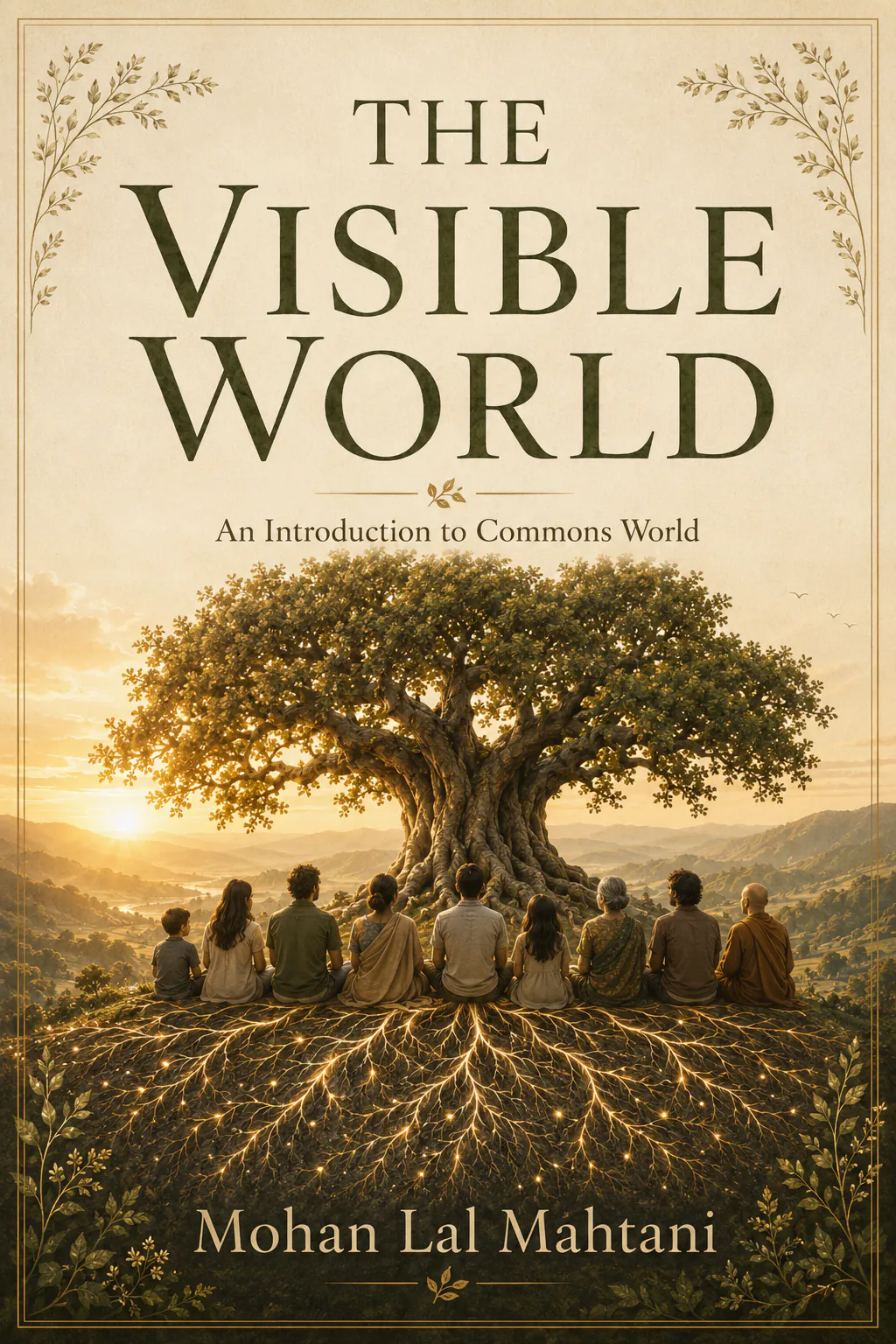
The Visible World — book cover

Book three · The founding book

The Visible World

The complete framework — full nine-Pillar architecture, research, glossary, evidence base.

In print 2027

A single tree in a golden field, under open sky

Why these books?

A world worth describing carefully

Commons Community and The Hidden World exist because the world they describe is worth seeing clearly — not as a slogan, but as an architecture: who is accountable for what, who is contributing, who is benefiting, and who is bearing the cost.

Both books are free, for everyone, always. The Visible World, the founding book, sets out the complete framework in full — arriving in print in 2027.

Ways to read it

Free, in the way that suits you

Read on screen or print

Both PDFs — the complete layout, footnotes, and figures. Yours to keep, free to print and share.

Get the PDFs

The two essays

The AI Claim and The Infrastructure Claim — read online or download, free.

Read the essays

The essays

Two analytical essays accompany the books

Each is free to read on its own, alongside Commons Community and The Hidden World.

The AI Claim

The concentration of artificial intelligence capability in the hands of a small number of corporations represents one of the most significant power shifts in human history. This essay examines AI ownership, synthetic information environments, and what Commons World’s accountability framework requires in response.

Essay

The Infrastructure Claim

The current wave of AI infrastructure investment — data centres, compute networks, energy systems — is reshaping the physical geography of power. This essay maps the investment landscape, identifies the accountability gaps, and sets out the role Commons World institutions must play.

Essay

Share the books

Both books are free because the ideas in them belong to everyone. Please share them freely.

Frequently asked questions

Are the books really free?

Yes — two books are free now; the third is forthcoming in print.

  • Commons Community — free PDF, always, licensed CC BY-NC-SA 4.0.
  • The Hidden World — free PDF, always, licensed CC BY-NC-SA 4.0.
  • The Visible World, the complete founding book — forthcoming, in print, in 2027.
Which book should I start with?
Start with Commons Community — the entry point, meant to be read in one sitting and used as a meeting guide. Then follow the evidence in The Hidden World, which expands each of the twelve priority challenges into a full, sourced chapter.
Is Commons World a political party or a manifesto?
No. It is a governance framework — a design document specifying nine interlocking institutions, meant to be built, tested, and improved.
Who wrote it, and where?
Mohan Lal Mahtani, written from Lagos, Nigeria, with particular attention to what governance failure looks like from the Global South — and built with openly-credited AI collaboration.
What format are the books in?
Free PDF now, both books, at commonsworld.org. The Visible World, the complete founding book, arrives in print in 2027.
What’s inside?

Two different books, two different jobs.

  • Commons Community (about 119 pages) — the field guide: an honest invitation, how to run a Commons Community, your first steps, the nine Pillars, the twelve priority challenges, and questions & answers.
  • The Hidden World (about 181 pages) — the evidence companion: a full chapter for each of the twelve challenges, sourced case by case, plus the Nine Pillars in full.

Begin with the books

Commons Community and The Hidden World are the beginning of the question — what becomes possible when actions and consequences are easier to see?